
Apple Has Updated the Mac mini and Mac Studio. Here's Who They're For
Published:
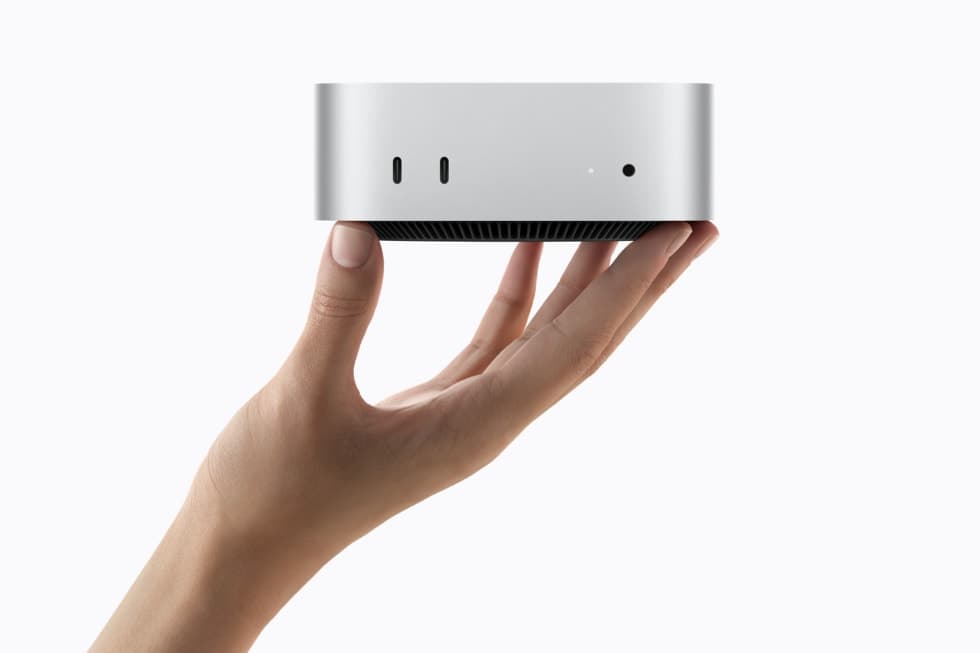
Image:
Apple Newsroom
Apple updated two Macs yesterday, and it did it quietly, with a press release rather than an event. The Mac mini gets a brand new chip called M6, the Mac Studio moves up to M5 Max and M5 Ultra, and both are available to pre-order now with delivery and store availability from Tuesday 22 September.
Most of what Apple had to say was aimed at professionals and people running AI models on their desks, which is fair enough, but there's a version of this news that matters to everyday Mac owners too, so let me pull that part out for you.
Mac mini with M6, from £899
M6 is the headline here. It's Apple's first chip built on a 2 nanometre process, and Apple is calling its main CPU core the fastest in the world, which is quite a claim for a computer the size of a paperback. In plain terms, it's a noticeably quicker chip than the M4 in the previous Mac mini, with Apple quoting around 40 per cent faster CPU performance and up to twice the graphics speed.
The rest of the spec is sensible rather than exotic, which I mean as a compliment. You get a 12-core CPU and 12-core GPU, 16GB of memory as standard with the option of 32GB, three Thunderbolt 4 ports, HDMI and Ethernet on the back, two USB-C ports and a headphone jack on the front, and Wi-Fi 7 and Bluetooth 6 throughout.
It starts at £899, or £799 with education pricing. That's a step up from where the Mac mini used to sit, and it's part of a wider shift in Apple's UK pricing this year that I'll come back to another time, but it's still the cheapest Mac desktop Apple makes by some distance.
Mac mini with M5 Pro, from £1,699
The bigger brother gets M5 Pro, with up to an 18-core CPU, a 20-core GPU, up to 64GB of memory and Thunderbolt 5. This is for people editing video, working through large photo libraries at speed, or running serious software all day long, and if you find yourself wondering whether you need it, you almost certainly don't.
Mac Studio, from £2,499
Mac Studio now comes with M5 Max at £2,499 with up to 128GB of memory, or M5 Ultra at £5,499 with up to 512GB. The Ultra is Apple's most powerful chip ever, made from four dies joined together, and it's built for studios, developers and researchers. Not for most of us, and that's completely fine.
Who should actually care
If you have an Intel Mac, you're the group I'd talk to first. macOS 27 doesn't support Intel Macs at all, so if yours is a 2019 iMac or a 2018 MacBook Pro, you're now on the last version of macOS it will ever run. A Mac mini with M6 at £899 is the most affordable way onto a current Mac, provided you already have a screen, keyboard and mouse or you're happy to buy them, and almost any monitor with an HDMI socket will do the job.
If you want a desktop and portability isn't the point, the Mac mini is small enough to tuck behind a monitor and quiet enough that you'll forget it's there. For photos, email, browsing, Office and the odd bit of video, the base model is more than enough and will be for years.
If you'd rather have a laptop, the MacBook Neo starts at £699 and would be my suggestion for most people who don't need a desk setup. I wrote about it earlier this year and my view hasn't changed.
And if you already have an M1, M2 or M3 Mac, stay exactly where you are. Your Mac gets macOS 27 and all of the Apple Intelligence features, and while the M6 is faster on paper, you won't feel the difference in everyday use.
What's next
Apple usually holds its iPhone event in the second week of September, and this update clears the Mac out of the way beforehand. So expect iPhones, watches and AirPods next month, and no more Mac news for a while.
If you're weighing up a Mac mini against something else, or wondering whether your Intel Mac has a bit more life left in it, book a session and we'll work it out together. I'd much rather save you money than sell you a computer you don't need.