
iPhone Duo: Apple's First Folding iPhone, Explained
Published:
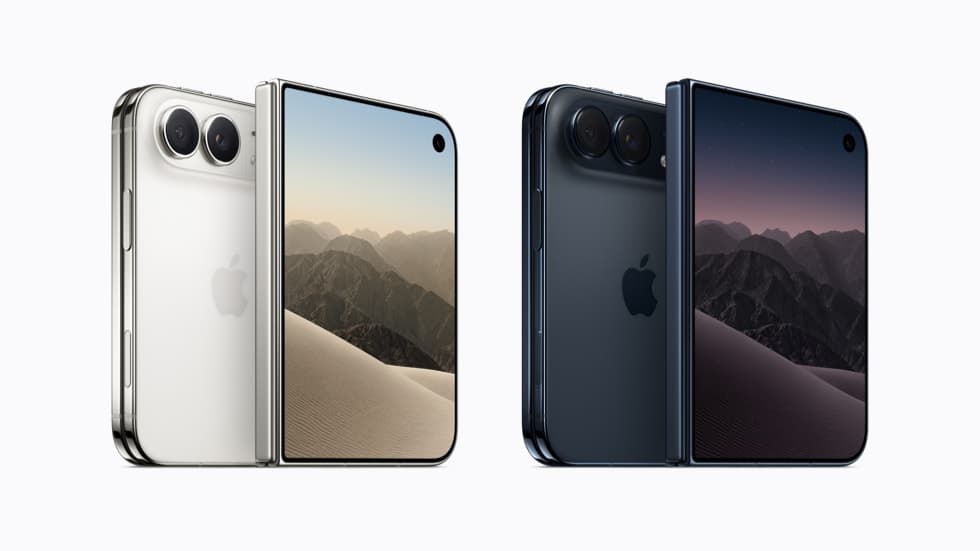
Image:
Apple Newsroom
Well, Apple finally did it. The company announced its first folding iPhone today, it's called iPhone Duo, and John Ternus called it "the most transformational change to iPhone since the original". That's a big claim to open with, so let me walk you through what it actually is, what it isn't, and whether it's something you should be thinking about.
Two screens, one phone
Closed, iPhone Duo is a different shape from the iPhone you're probably holding now. It's shorter, at 117.8mm tall against the 150mm of an iPhone 18 Pro, but it's also wider, at 84.1mm across against 71.9mm, which makes it wider than any iPhone Apple has made. That gives you a 5.4-inch screen on the outside in a squarer, more passport-like shape. Open it like a book and you get a 7.6-inch screen on the inside, which is the largest display Apple has ever put on an iPhone and puts it much closer to a small tablet than a phone when it's open.
Both screens are OLED with ProMotion and Always On, and Apple quotes 3,000 nits of peak outdoor brightness, so it should be readable in the sun. The inner screen has a nano-texture finish, which Apple says reduces glare and minimises how visible the crease is. I'd note the word minimises there, because there is still a fold running down the middle and Apple isn't pretending otherwise.
Open, it's just 5.2mm thick, which makes it the thinnest iPhone Apple has ever made, and closed it's 11.3mm and weighs 254g. The body is titanium, the hinge alone has more than 100 components, and it carries the same IP68 water and dust rating as the rest of the range, which I was pleased to see on a first-generation folding phone.
Touch ID, not Face ID
This is the change that I think will catch people out. iPhone Duo uses Touch ID built into the side button rather than Face ID, and Apple's reasoning is that unlocking should work the same way whether the phone is open or closed. That makes sense, but if you've relied on Face ID for years it's a real shift in habit, and if you use Face ID for accessibility reasons it's something worth thinking carefully about before you order.
eSIM only
There's no physical SIM tray at all. iPhone Duo is eSIM only, everywhere in the world, and Apple lists EE, O2, Vodafone, Three and Sky Mobile as supported here in the UK. If you're with a smaller network, I'd check with them before you buy rather than after.
Chip, cameras and battery
Inside is the A20 Pro, the same chip as the new iPhone 18 Pro. It's built on a 2 nanometre process and Apple claims up to 35 per cent better sustained performance than the iPhone 17 Pro, which in practice means it should handle two apps side by side without breaking a sweat.
The cameras are a 48MP main and a 48MP ultra wide, with what Apple calls an optical-quality 2x telephoto built into the main camera rather than a separate long telephoto lens like the Pro models have. It records 4K video at 120 frames per second, and there are two front cameras, one hidden under the inner screen and a Center Stage camera on the outside.
The clever part is what the outer screen does while the phone is open. Duo Preview lets the person you're photographing see themselves on the outer screen while you use the main cameras, and Kid Cue plays Peanuts animations on the outside to hold a child's attention long enough for a photo. They're small ideas, but they're the kind that actually get used, and I can already think of a few grandparents who'll love the second one.
Battery life depends on which screen you're using. Apple quotes up to 44 hours of video on the outer screen, up to 31 hours on the inner one, and up to 24 hours if you split your time between them, and charging gets you to 50 per cent in about 20 minutes with a 60W adapter.
Software built for it
iPhone Duo ships with iOS 27.1, and Apple has reworked the interface to suit it. The Dock and Lock Screen controls move to the sides so that content fills the screen, and it's the first iPhone that can run two apps side by side in Split View, which is something iPad owners have had for a decade. StandBy works on either screen without needing a charger, and Apple says Apple Pencil support is coming later this year on both displays.
Price and dates
It starts at £1,999 for 256GB, then £2,199 for 512GB, £2,599 for 1TB and £3,199 for 2TB, in two colours, Star White and Night Sky. Pre-orders open on Friday 16 October at 1pm UK time and it arrives on Friday 23 October. The official case is £79 and the Folio with Kickstand is £129, should you want either.
Who it's for
Let me be honest with you, because that's what you come here for. This isn't the iPhone for most of the people I look after, at least not this year. It's a first-generation product at £1,999, it changes the way you unlock your phone, and it drops the physical SIM, and those are three things I'd want to see settle down before I recommended it to anyone who relies on their phone and doesn't particularly enjoy change.
Who it is for, then? People who carry both an iPhone and an iPad mini and would love one device that does both jobs. People who read, watch and work on their phone and want a bigger canvas without a bigger pocket. And, if we're being honest, people who simply want the new thing and have been waiting years for Apple to do folding properly.
If that's you, I'd still suggest going to see one in person before you commit. Fold it, feel the crease, try Touch ID, and see how it sits in your hand. And if it's not you, the iPhone 18 Pro and the iPhone 17 are both very good phones, and I've written about who should upgrade to which.
Wondering whether it fits the way you use your phone? Book a session or send me a message, and there's no pressure either way.